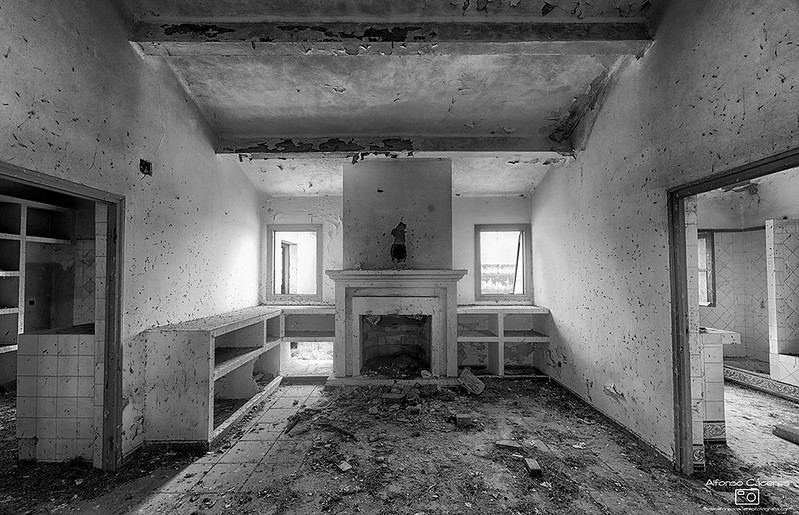
(Photo credit: Alfonso Cr (2016), ‘Urbex’. https://flic.kr/p/GEyimX (CC BY-NC-ND 2.0 DEED))
My social media timelines are a dissonant mix of serious AI researchers, enthusiastic AI evangelists, marketers and shills, and earnest AI sceptics and opponents. And so I’ve been wondering about the character of opposition to AI, generative AI particularly.
Some of it is understandably self-interested, coming from creatives and others whose livelihoods are already being upended. Some of it is more analytical, coming from maths and computer science academics who claim to be able to see through the LLM parlour trick. Some of it is retaliation for the embarrassment of not having seen gen AI coming, from ‘futurists’ who, that’s right, failed to see gen AI coming.
There’s a dissonance of another kind, too, between the jubilant embrace of the latest release, and the persistent sense of dread at what is coming next.
Both sides share one thing though – an utter lack of control or ownership.
And so we may regard generative AI as being a degenerative innovation. And I am not referring here to the environmental costs of running these systems. I am referring to the lack of any regenerative purpose on the part of the companies developing and marketing generative AI systems.
Gen AI is degenerative since it does not promote broad community wellbeing; rather, it provokes ‘AI anxiety’ and loss of prosperity.
Gen AI is degenerative as it does not generate or preserve real wealth; rather, it accumulates speculative, financialised wealth in the stock prices of companies and remuneration of executives.
Gen AI is degenerative because it assumes that these companies’ rights to extract wealth should be unchecked and unlimited. It is degenerative because it prolongs the normalcy of the assumption that corporations should be able to make a killing, at the expense of ordinary people’s ability to make a living.
Gen AI is degenerative as it puts maximisation by a microscopic elite before fairness for us all.
Gen AI is degenerative because it is programmed to regurgitate ad nauseum superannuated assumptions, paradigms and falsehoods which were shown to have failed catastrophically in the 2000s, while distracting us from other ontologies.
Gen AI is degenerative because it doesn’t serve our communities; rather, it feeds on us, on our content, our data, our rights and our privacy. It is extractive and divisive, it avoids responsibility for our losses, and it doesn’t care at all about the prosperity of our living systems.
Gen AI is degenerative. Or at least, the business models of the companies are degenerative. So the question becomes: can AI be regenerative?
For AI to be regenerative, it must enable us to generate and preserve real wealth (not just financialised wealth).
For AI to be regenerative, it must promote community wellbeing. It must enable or support individuals, families and communities to be financially self-sustaining, and prevent wealth extraction and maximisation by absent minorities.
For AI to be regenerative, it must promote and sustain fairness, sustainability and community, the fundamental values of the generative economy, and it must do so by design, through its normal functioning, and not as a regulatory compliance exercise or CSR/ESG afterthought.
Is there a regenerative purpose for generative AI? Or is it the equivalent for our times of the credit default swaps and other esoteric algorithmic financial products of the 2000s, that no one sees, few understand, and from which even fewer benefit, and through which we all ultimately lose our home?
This post is accompanied by a black and white photo by Alfonso Cr, dated 2016 and entitled Urbex, in which we see the interior of the kitchen of a formerly grand and lavishly decorated house. There is a large carved stone fireplace at the centre, and marble counters and shelves. To either side we can just see into adjoining rooms, decorated with painted tiles. However, the rooms are abandoned and in a ruinous state, the floor of the kitchen is covered with rubble and debris, the plaster is falling from the ceiling, and the walls are cracked, peeling and pitted with holes.
 Matthew Moran
Leave a comment