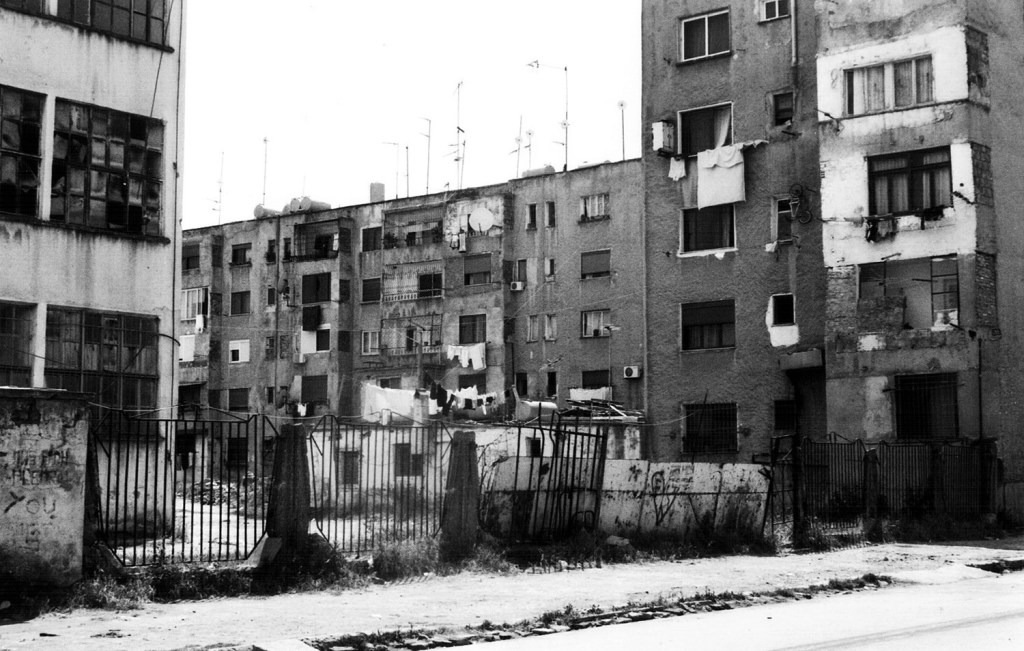
How do we respond in chaos? In this post I reflect on my experience of witnessing response patterns of individuals and groups in the aftermath of the collapse of Stalinism in Albania in the early 1990s, patterns which I have observed in the intervening decades in business and organisations, even in my own family, when faced with crisis and chaos.
I have been reflecting on my experience of witnessing the collapse of Stalinism in Albania in the early 1990s, and how people reacted in the chaos.
It was brutal, harrowing and frequently violent to observe. Over the last nearly 30 years I have often thought back to it and what I observed of how people react to chaos and crisis — and naturally those memories are vivid in these days of covid-19.
Albania was under a brutal and repressive form of Stalinism from 1944 right up to 1990, under Enver Hoxha then Ramiz Alia.
For nearly 50 years the people of this European country were almost entirely isolated from the world, in harsh poverty, and subject to years of purges and political terror.
Then suddenly it collapsed. The regime, which was the one system, the one way of life, that most Albanians had ever known, very quickly disintegrated, leaving the already weary and impoverished people frightened and confused.
Some people refused to believe the rumours as news of the regime’s fall spread slowly. Labourers on regime farms continued working, in some places for two years, despite seeing other Albanians fleeing through the landscape.
They carried on working out of terror, fearful that the news was a trick designed to test their obedience, and believing they would be brutally punished if they put down their tools. But also I suspect because this work was all they knew, they couldn’t yet conceive any new reality.
Other people froze, stunned. Just as the regime’s factories and bureaucracy fell still, people stood around in the streets, all day and in all weathers, even in the pouring rain, surrounded by a present that was now history, and waiting for a future still to arrive.
Others took the deadly gamble of attempting to leave. Some overland to northern Greece, many more by boat, some even swimming, to nearby Corfu. Many died.
Many tried again and again to leave. This was not ‘migration’, as we have been conditioned by politicians and the media to see it. It was more like extreme tourism. I once, very foolishly, accepted a ride on a small boat from Butrint in southern Albania to Corfu, for a night of drinking and clubbing. The passengers in the boat were given hollowed-out watermelon shells and told to bail out with the watermelons on our heads if we encountered the Greek navy.
The morning after you would see these extreme tourists (and they weren’t all young or male) being rounded up by the Greek police and forced onto the daily small ferry back to Saranda, many proudly taking home stolen or scavenged goods, washing machines, mopeds, chainsaws — extreme tourists back from the future.
Other Albanians took on self-appointed roles as custodians of the cultural and environmental patrimony, cultural sites, churches, archaeological monuments, landscape features.
Of course, many left the country, especially the more wealthy, educated and connected, but not only them — I knew a baker who promptly emigrated officially to Canada.
And of course, others turned to crime in the lawless period in the immediate aftermath of the regime’s fall, when organised criminals took over the (black) market for gasoline, aluminium, cars (mostly stolen German Mercedes), cigarettes, cola, drugs and other western goods, and laundered their money via restaurants and construction.
I’ve often reflected on these responses:
- people who continued, in denial and fear
- people who froze in the interval between past and future
- people who sought out the future, first tentatively, then more confidently but at great risk
- people who cared for and protected the patrimony
- people who left
- and criminals.
And I’ve seem them again and again, these responses, in the intervening two decades. I have seen these responses in the businesses where I have been employed, and in those whom I have advised. And I have seen them even in my own family, when we experienced the trauma of losing a parent, homelessness and poverty.
Of course, the responses are not fixed or permanent. In Albania, some who continued later became frozen. Some who left later returned to join the custodians (or the criminals).
But it is possible to make some observations on these response patterns that seem pertinent in these days of the covid-19 crisis.
My interpretation has been that the continuers and the frozen have hard times and poor outcomes. They quickly start to define themselves with their tragedy, and find it hard if not impossible to move on.
Not so the extreme tourists, the custodians and the leavers — they do not allow the tragedy to define them, they look beyond it, they find something in them selves that is resistant to it, and courage and optimism. They do better than the others.
There seems to be something about the quality of our initial response to chaos that determines our future. Our initial responses to chaos seem to condition and constrain our subsequent choices and actions.
So as we face the current covid-19 crisis, let’s be careful to choose our responses, not be chosen (and broken) by them.
There are lots of people out there promoting theories and models for understanding complexity, chaos and crisis. Some of them are good people and good models. History is also an excellent teacher. This is part of my history. And I continue to find it a rich store in these days of anxiety.
Thanks for reading.
(Photo: Communist-era housing adjacent to disused factory, Durres, Albania, by Zach Korb, Flickr https://www.flickr.com/photos/zkorb/ CC BY-NC 2.0)
 Matthew Moran