
The discovery mindset is the mindset we need for successful living in a complex world
Discovery is the mindset we need to create and launch new products and services. And discovery is the mindset we need to sustain successful interventions in human complex systems such as organisations, and when attempting business change.
Discovery helps us to work with and even to exploit situations of volatility, uncertainty and ambiguity.
It enables us to make sense of our environment and take informed decisions about how to act.
The discovery mindset draws from agile software development, lean startup, systems thinking, social or anthrocomplexity theory, resiliency and antifragility, hybridisation, syncretism, and related strategy models such as Cynefin, VUCA and OODA.
The discovery mindset is easy to adopt — there are no frameworks, no training courses, no certifications, no membership fees, and no consultants.
The discovery mindset is free but it demands commitment and practice. And so discovery is hard to do because we humans are lazy, and because organisations have special powers to destroy our new habits.
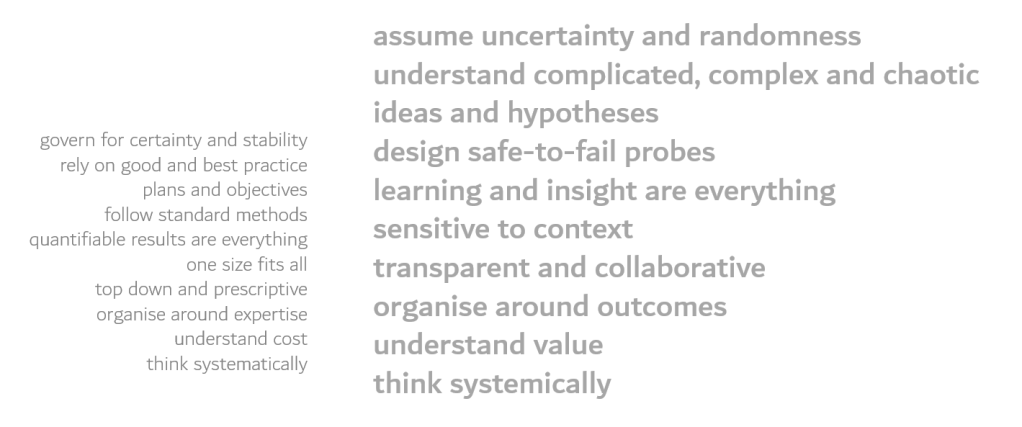
The 10 shifts towards the discovery mindset
So to help you, here are 10 things we can do to build the habit and grow the discovery mindset.
First, the discovery mindset accepts that the world is complex and random, rather than lazily assuming the world to be simple, stable and predictable.
Second, the discovery mindset seeks to distinguish between situations that are merely simple or complicated, and others that are complex and chaotic, and therefore figure out the best actions to take in a given context.
The discovery mindset values ideas and hypotheses over visions and plans.
The discovery mindset in action designs and executes safe-to-fail probes. These are experiments designed to test our ideas and hypotheses by pushing us beyond our current knowledge. Probing gives us better understanding and helps us to figure out what to do next based on feedback from the environment.
Feedback, learning and insight are everything in discovery.
In discovery, we are aware and respectful of context, we treat different contexts as unique, and we are suspicious of one-size-fits-all ‘solutions’ imported from other contexts without regard to the uniqueness of this context.
Next, in discovery, individuals are useless – instead we need the power of socially and cognitively diverse teams.
And we need to work with radical collaboration, in open space, where we can see, hear, be heard, ask questions, make sense, dissent, disagree, inspect, adapt and learn together.
In discovery it makes best sense to organise so that our teams have a wider rather than a narrower range of knowledge, skills and capabilities.
In discovery, individuals are useless and so too are single business functions or silos, just as a chair with one leg or a bicycle with one wheel is useless.
In discovery we understand and focus on value creation first, before cost, and we accept that often the value we create is unquantifiable by accountants, so we use alternative metrics, innovation accounting, chained leading measures, and pirate metrics – AARRR!
Finally, the discovery mindset means we think systemically, we understand the properties of human complex systems, we recognise that there is a non-linear relationship between cause and effect, and there may be neutral or negative correlation between intervention and outcome. In other words we accept that we only influence, we do not control.
And so we avoid local, top-down, pre-determined and deterministic change on the basis that this kind of change is wasteful (because it always fails), stupid (because we know it always fails), disrespectful (because the system we seek to change is people, our peers), and arrogant (because who the hell do we think we are, anyway?)
So this is the discovery mindset, a mindset for successful living in a world of uncertainty, complexity and change. And these are some of the thinking patterns we can practice to train ourselves to grow the discovery habit.
And if you’d like to learn more or get support with your discovery journey, you can contact me and I can help you.
 Matthew Moran