This planning technique from software and digital product development can be used to support and embed new behaviours for organizational change
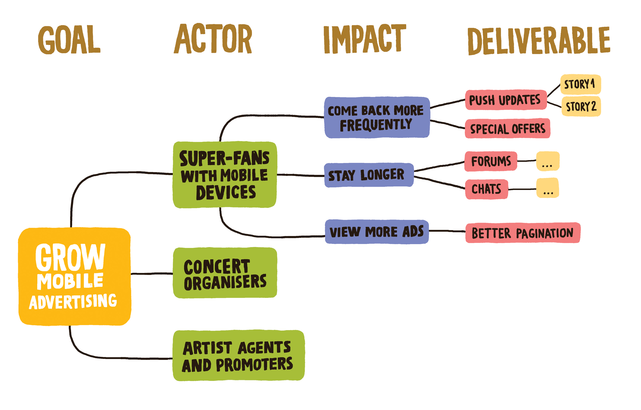
https://www.impactmapping.org/drawing.html
Impact mapping is a strategic planning technique for software products and projects. It is a simple, visual technique for mapping four things:
- the goal we are trying to achieve
- actors (or stakeholders) whose actions or behaviours we seek to influence or change
- impacts, or how these actors’ behaviours may change to support our goals, and
- deliverables, or the activities or interventions (or software features) we can develop to support the required impacts.
Impact mapping was developed by Gojko Adzic and published in his book of 2012. Gojko gives a number of worked examples of impact maps for software products and projects like the one shown here.
This is a very immediate way to visualise scope and assumptions for complicated projects. Impact maps are quick and cheap to produce. The process of creating and revising impact maps is collaborative, and creates interactions between different groups of people, including technical delivery experts and business users. Impact maps help these groups to understand the goal, scope, actions and expected impacts in the same way. Impact maps force teams and organizations to justify actions and deliverables according to business objectives. Better products. More business value. Less waste.
But what if the actors whose behaviours we may wish to influence or change were inside the organization?
We are using impact mapping to support organizational change in a UK university. This university is experimenting with agile practices for the development of online courses. The course teams are made up of academics, project managers and content developers. They are all working on multiple missions and projects at once, so they struggle to find the time for training courses. The university doesn’t yet have an established agile development approach, and so under these circumstances it is very easy for individuals and teams to slip back into old ways of working.
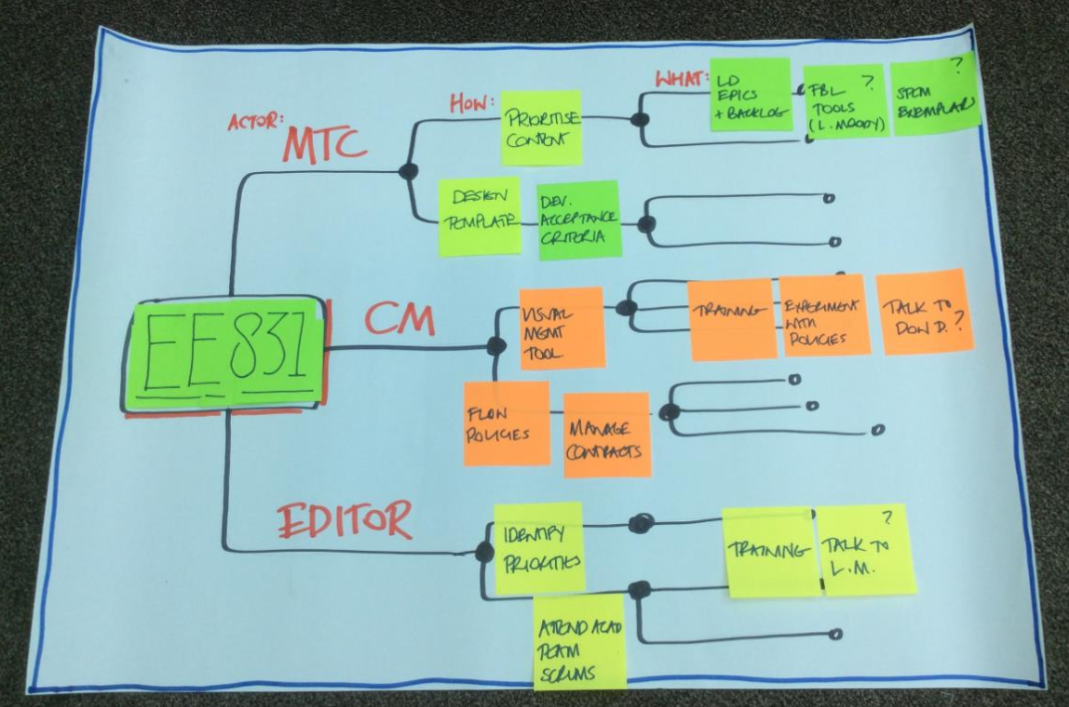
We are using impact maps, like the one shown here, to help these university teams stay the course. The teams tell us they find it extremely valuable to be reminded of the goal of the work (easy to forget in the press of multiple other responsibilities). Teams tell us that the maps help them to know ‘this is what I have to do and how’. And above all they tell us about the power of the deliverables: ‘this is what I have to do and how, and this is what is happening to support me to make the change stick.’
Impact maps can be easily changed and updated as the team and the project lifecycle progress. We find that the process of making and revising the maps not only creates engagement and participation, it also enables the team and the organization to learn about what works.
Why not try using impact maps with your teams? This is a simple, cheap and quick technique with serious benefits.
 Matthew Moran